Archive to past emails
04/05/2026- A Distinguished Member

A Distinguished Member of the Humane Society, 1838
Sir Edwin Henry Landseer (1802-1873, English)
Tate Gallery, London
Imagine having a breed of dog named after you- what kind of things do you need to do to be that famous? Several breeds have been named after the people who founded the breed (the Dobermann and the Jack Russell Terrier for examples) and at least one has been named after a fictional character (the Dandie Dinmont Terrier). And of course, there’s the King Charles Spaniel named after King Charles II but there’s only one dog breed I’m aware of that’s named after a man who was not royal and also had nothing to do with the creation of the breed. That’s the Landseer dog, named after Edwin Landseer, an artist known for his paintings and sculptures of animals.

Alpine Mastiffs Reanimating a Distressed Traveler, 1820
Sir Edwin Henry Landseer (1802-1873, English)
National Gallery of Art, Washington D.C.
Sir Edwin Landseer was only 13 when he exhibited his first artworks at the Royal Academy as an “Honorary Exhibitor”. One of his earliest paintings, “Alpine Mastiffs Reanimating a Distressed Traveler” (1820), is believed to be the origin of the idea that St. Bernard rescue dogs in the Alps carry brandy in the casket on their collars. In 1841, Queen Victoria commissioned Landseer to paint a Christmas present for her husband, Prince Albert. The painting was “A Favourite Greyhound of Prince Albert”, featuring Eos, Albert’s favorite greyhound. Throughout his career, Landseer painted many dogs, including hounds, poodles, bulldogs, and mastiffs, but his most famous contribution to the world of dogs was his paintings of Newfoundlands.

Princess Mary of Cambridge with Nelson, a Newfoundland dog, 1839
Sir Edwin Henry Landseer (1802-1873, English)
Royal Collection Trust, United Kingdom
The Newfoundland was originally bred and used as a working dog for fishermen on the island of Newfoundland, before it became part of Canada. Throughout the years they have become well known as water rescue dogs due to their friendly nature and webbed paws. While most people know of the black Newfoundland, this is a slightly newer coat color. In the Victorian era, white coats with black spots were more popular and were the subject of a number of Victorian-era artists, including Sir Landseer. In the early 1900s, the solid black coat became more popular to the point that in the 1930s, a concerted effort was made to recreate the dogs seen in these paintings and they were given the name of the artist who loved them so. Using the term “Landseer” for this coloring is seen as early as 1896, but it wasn’t until the mid-1900s that this term became standard. In the US and the UK, the Landseer is considered a variety of Newfoundland but in continental Europe, the Landseer is actually considered its own breed, making Sir Landseer, possibly the only non-royal, non-breeder to have a dog breed named after him.

Lion: A Newfoundland Dog, 1824
Sir Edwin Henry Landseer (1802-1873, English)
Victoria and Albert Museum, London
Sir Landseer painted the Landseer at least four times. “Lion, A Newfoundland Dog” (1824), “A Distinguished Member of the Humane Society (1838), "Princess Mary of Cambridge with Nelson, a Newfoundland dog" (1839), and “Saved” (1856). Of these, “A Distinguished Member” is probably his most famous. The dog in this painting is meant to be “Bob”, a dog that was found in a shipwreck off the coast of England. No one knew where the dog came from so he lived on the London waterfront as a stray. During his time there, he became known for saving people from drowning, supposedly a total of 23 times over the course of 14 years. For this, he was made a distinguished member of the Royal Humane Society which granted him a medal and all the food he could want. This painting is one of my personal favorites for a number of reasons. For one, the title is hilarious. Sir Landseer was known for his long and descriptive titles so this wasn’t out of character for him. The way the dog is sitting, paws gently draped over the stone, eyes alert but body calm, absolutely makes him seem like a distinguished British gentleman. He is literally placed on a pedestal! And the funniest thing of all is that he was, in fact, a distinguished member! Although the dog probably didn’t know the difference between a distinguished membership and a normal one, the dignity he was painted with makes it easy to believe that maybe, he was proud of himself.
03/01/2026- Mechanical Dog

Mechanical Dog (1390 BCE - 1352 BCE; 18th Dynasty)
Egypt
The Metropolitan Museum of Art
This dog is a fascinating innovation of ancient engineering. Unfortunately, not much is known about the provenance of this piece. What we know is that it was purchased by the museum from the estate of Howard Carter in 1940. Howard Carter worked in Egypt from 1891 until 1932. He was most famous for his discovery of the tomb of Tutankhamun in 1922 although he was simply the overseer of the workers who discovered the tomb. After his death in 1939, the executor of his will, Egyptologist Henry Burton, identified at least 19 items in Carter’s collection that had been taken from Tutankhamun’s tomb without authorization by the Egyptian government. Since this was considered a “sensitive matter that could affect Anglo-Egyptian relations”, Burton ended up selling several of the items to the Metropolitan Museum of Art with several more going to the Egyptian Museum in Cairo. In 2010, nineteen objects, including a small bronze dog, were returned to Egypt after they had been identified as originating from King Tutankhamun’s tomb.
During the excavation, there were many problems with the way Carter acted with objects at the site. The Antiquities Service, a department of the Egyptian government, required that an inspector be on site at all times and that Carter submit a list of all his personnel for approval. While this may seem like common sense and has since become the norm, this was a new way of doing Egyptological digs brought on by the importance of this tomb which Carter hated. Another change was the end of the traditional division of finds. Previously, half of all artifacts went to the Egyptian government and half went to the excavators and sponsors of the site. Now, all artifacts found in an intact tomb, such as Tutankhamun’s was, went to the Egyptian government. This, along with several other slight slights that the government and the excavators made on each other, led to a strike in 1924 that lasted until early 1925. During this strike, the Egyptian government sent a committee to investigate the unfinished excavation. Among the other materials that had been left behind, they discovered a wooden bust of Tutankhamun packed in a crate that was not included in the excavation notes. The committee members suspected that Carter had intended to surreptitiously remove the bust from the site. When asked about it, Carter responded that the bust had been packed because it was too fragile to be moved otherwise.
So does this mean this dog was for sure stolen? Not necessarily, this law only really applies to tombs opened after King Tutankhamun’s. Carter had about thirty years of experience in Egypt before the finding of Tutankhamun’s tomb including a handful of notable excavations in the Valley of the Kings in the early 1910s. Maybe you’re wondering, how does one go about determining if an object came from the Tutankhamun excavation or not? Interestingly enough, one thing that Carter did well was take a lot of notes, photos and drawings of the excavation. The process was one of the most methodical and scrupulous for its time. This is how, in 1934, Alan Gardiner, scholar of the Egyptian language, realized that the amulet that Carter had given him as a gift had been stolen from the tomb which led to a falling out between the two of them. The nineteen pieces from the Met that were returned to Egypt, were noted in the tomb records although they do not appear in any excavation photographs.

Small Bronze Dog (1332 BCE - 1323 BCE; 18th Dynasty)
Egypt
Grand Egyptian Museum, Giza
For the ivory, mechanical dog, it is believed that he was found during one of the earlier excavations done by Carter. It’s dated to around 30 years before Tutankhamun to his ancestor, Amenhotep III. While not the first person to discover or excavate Amenhotep III’s tomb, Carter was the first person who had significant documentation when he excavated the tomb in 1915.
In my opinion, this is part of the problem with private collectors. While museums (often but not always) keep dedicated documentation on items’ provenance, private collectors do not. In 2019, the auction house Christie’s sold a bust of King Tutankhamen for $6 million which resulted in the Egyptian government suing Christie’s after they refused to repatriate it. The owner previous to the sale was a private collector in Germany who bought it from an art dealer in 1985. Christie’s claims they did their due diligence verifying the provenance, while the Egyptian government claims that they have not been provided any proof of ownership documents nor any evidence that proves the statue’s legal export from Egypt. Moving away from Egypt, the well-known “Dogs Playing Poker” series by Cassius Marcellus Coolige is mostly owned by private collectors. While you can see recreations all over, the sixteen original oil paintings are (I believe) all in private collections. I was incredibly disappointed finding this out, knowing that I would most likely never get a chance to see the painting myself because we don’t know where it is. For all we know, it could be destroyed or hidden in a vault or in an attic somewhere. The point is, private collectors lack accountability. Unless they have all their legal ducks in a row, which is rare, the provenance can easily break down, losing important information about the piece and where it came from.
This is especially obvious in ancient pieces like this. This ivory hunting dog has a lever on the belly that opens up his mouth, showing his teeth and a red tongue. This brings up a multitude of questions, was this a toy for children? Or a fun party piece for adults? Assuming that it was a grave good, why was it buried where it was? And with whom? Not all of these questions can be answered but knowing the provenance can help. There were a few toys found in Tutankhamun’s tomb, possibly because he was so young when he became pharaoh, about 8 or 9, and when he died, about 18-19. Maybe this was one of Amenhotep III’s toys from his childhood. We know that dogs were important to the Egyptians, especially in the afterlife and we know that the people who were buried with items were mostly the wealthy, the royals, and the higher-ups so dogs were fairly common in tombs. In the end though, we can only speculate.
Anyways, thank you for reading my long and rambling rant about colonialism, provenance, and how Howard Carter was 100% a thief. I probably could go on even longer about how complicated repatriation can be and how awful Carter was during the exhibitions but I have been writing for long enough. See you next week (hopefully) for a very distinguished gentleman!
02/22/2026- Last Supper

Laatste Avondmaal/ Last Supper, 1655
Jacob Jordaens I (1593-1678, Flemish)
Royal Museum of Fine Arts, Antwerp
This painting is a great example of what I call “dogs watching”. There are so many paintings out there where the dog is not the main character of the painting. Likely, no one is even paying attention to the pup. This dog is just hanging out, watching what’s going on. Sometimes these dogs are painted in to represent something, often loyalty or fidelity. Sometimes there is no apparent reason for the dog other than maybe the artist just likes dogs. This dog almost definitely represents something but what it represents is where it gets interesting.
This is Last Supper by Jacob Jordaens, a Flemish painter from the 17th century. One of the leading Flemish Baroque painters of his time, Jordaens made many paintings for the wealthy bourgeoisie and local churches. This piece, showing the biblical scene of the Last Supper, was made from St. Paul’s Church in Antwerp. For those of you who didn’t go to Sunday school, the Last Supper is the biblical story of Jesus’s final meal with his apostles where he tells the twelve that one of them is going to betray him soon and lead to his death. His apostles are astonished and some of them are very upset at this accusation. However, Judas is aware of this fact as he has already taken payment from Pontius Pilate’s soldiers to betray Jesus later that evening. In Jordaens’ painting, Judas is most likely the figure sitting in front of Jesus, with the dog in his lap. There are a couple reasons for believing that this figure is Judas. Most notably is the red hair. In Medieval Spanish culture as well as by Shakespeare and his contemporaries, Judas is often shown with red hair. This practice, unfortunately, most likely comes from the Renaissance portrayal of Jews with red hair which was then regarded as a negative trait. This makes the addition of the dog interesting. Why is Judas, the betrayer, petting a dog, normally associated with loyalty? There are a couple other interesting aspects to this painting. Most paintings include other symbols of Judas’s betrayal, such as a pouch containing the payment Judas took. The metal pot by Judas’s feet could represent a monetary gift, however, this most likely is of a ewer or jug used for wine or water, a completely normal thing to have at a supper. Most interestingly, to me at least, is the way Jesus and Judas look at each other. While there are many people looking at Jesus, he appears to be looking straight at Judas. Jesus’s hand also appears to be caressing Judas in some way. When you look very closely, it almost looks like Jesus is running his fingers through Judas’s beard which, as someone who has not studied art nor the Bible, I have no clue what that means. I will note, however, that his hair is a very similar color to the dog’s fur. I think there is a possible connection between how Judas treats the dog and how Jesus treats Judas. That being said, I have absolutely no clue what is really going on in this painting, only guesses, and I couldn’t find anything online. So if any of you know a religious art scholar, let me know, I want to know what they think.
Anyways, this is supposed to be a dog newsletter so lets get back to that sweet pup. Another possibility here is that the dog is a reflection of Jesus, both trust Judas and perhaps both will be betrayed by him. And that is the nature of the “dogs watching” category. Often, the energy given off by the painted dog is that they’re just hanging out. They’re not there to take care of humans or hunt or work, they’re just vibing. I think it’s nice to remember that dogs, even 400 years ago, weren’t these working, hunting machines that sometimes people make them out to be. Amongst all the dogs with jobs, there have always been pups who are just happy to be there.
02/01/2026- Colima Dog

Seated Dog, 200 BCE-300 CE
Colima, Mexico
The Metropolitan Museum of Art
This week’s pup is one of my favorite types of dogs, the Colima dogs! Colima is a state in south western Mexico and is where the Pre-Hispanic Comala people lived. The Comala people have become known for their burnished red pottery with which they created representations of people and animals. These dogs, also known as the fattened dogs, are one of the most famous, so called because of the rounded bodies and faces which, while very round, are still very close to their real references’ anatomy and natural attitudes. Many different scholars have proposed different interpretations on why these sculptures, often found in tombs, were dogs. The most common idea, and the most obvious to frequent readers of this newsletter, is that they represent nahual, the guardian spirit or animal companion of the deceased. It’s also possible that they represent deities or other supernatural beings such as the god Xólotl who took the form of a dog to accompany his brother Quetzalcóatl to the underworld to recover the bones of the dead. Dogs were also associated with new beginnings and there are some illustrations showing dogs near babies with the dog being considered a blessing.
The Colima dogs are most likely depicting an extinct breed of dog known as the Tlalchichi or Techichi. These dogs had longer tails and short, pointy ears and had a variety of coat colors. It’s believed that the Tlalchichi is the ancient ancestor of the Chihuahua. The Toltecs, who lived in the area after the Comala people, believed that these dogs had supernatural powers such as seeing into the future. Maybe that’s why my dog barks when there’s seemingly nothing around, she just knows that there will be something soon!
The Colima dogs remain one of my favorites because of just how round and dog-shaped they are. While some historical dog figures are hard to tell what they are to a modern-day viewer, these are absolutely, irrefutably dogs.
01/04/2026- Dog At Rest

Dog at Rest, 1650
Gerrit Dou (1613–1675, Dutch)
Museum of Fine Arts, Boston
This painting is one of my favorites because of the sweet, peaceful nature of this pup. Head resting on one paw, the tail curled around herself. It’s like a still life but better cause it's a dog and not a bunch of fruit or something. This pup was painted in 1650 by Gerrit Dou, one of the Dutch Golden Age painters. As part of the Renaissance, this era showed a cultural shift from valuing function to valuing aesthetic. During this time, dogs specifically began to be appreciated more not only for their service as guard or hunting dogs but also for their companionship and social presence. They began appearing more frequently in art as objects of affection rather than tools. Dogs also became more representative of class with the nobility of the Renaissance keeping dogs with recorded lineages and the working class keeping mutts as guard dogs. This dog certainly appears smaller but is most likely not noble. He has mismatched black ears and an unproportionally long tail. The pot behind him has a broken lid and the slippers on the right are fairly plain. This provides an interesting picture. Here is a dog possibly belonging to a working class family who’s not big enough to be a guard dog. However, he is still kept and given a place comfortable enough for him to rest. Now, of course, I recognize that this might be my own conjecture but it is not impossible to imagine a dog in the 1600s being kept by a working class family as a companion. The peaceful nature of this painting creates a lovely picture of a dog loved by his humans, whoever they may be.

Dogs at Rest, 400 Years Apart, 2025
Photo taken by Wendy Organ
11/09/2025- Plaque With Royal Family

Plaque with a Royal Family, 1st c. BCE
India (West Bengal, Chandraketugarh)
The Metropolitan Museum of Art
This week’s item is a plaque from Chandraketugarh, India, a cluster of ancient villages that were inhabited from 600 BCE until 1250 CE. The plaque has been dated to about the 1st century BCE (100-1 BCE) which was during the time of the Shunga Empire. The art during this era had less Persian art influences and were produced in more monumental forms then the previous Mauryan art form. This plaque is about 13 inches tall and 10 inches wide, not giant but still larger than pieces from the previous era. The plaque shows a family, believed to be royal, consisting of a loving couple and their child. The child is sitting next to two ducks and is holding the leash of a dog. The dog is in profile, unlike the people, and is sitting with his head pointing upwards. His ears appear to be small and pointed while his long fluffy tail is curled next to him. It’s possible that this plaque was once painted which may have given more insight into the origin of this family.
Most likely the dog here is an Indian dog or Desi Kutta. The ancestors of the Desi Kutta were present in Indian villages as early as 4,500 years ago. The Indian Dog is highly intelligent and easily trainable and so they are often used as guard dogs or police dogs. The history of the Desi Kutta is a complicated one. They are considered a type of Pye Dog also known as the Indian Native Dog (INDog) or as the Indian Pariah Dog. . The term “Pariah” originates from the Tamil word for “outcast” which was used by the British colonizers to refer to any stray dogs. The first recorded use of the term “yellow pariah dog” was in 1894 by Rudyard Kipling in The Jungle Book. In the present day, Pye Dogs are defined as “A subset of free-roaming village dogs, typical of the Indian subcontinent, representing an ancient or primitive dog morphotype” referring to dogs who can be considered stray or wild and “occupy the ecological niche of a scavenger in human settlements”. This differs them from the Desi Kutta since those dogs can be pets and/or guard dogs. However, the categories are fluid and it’s likely that dogs fluctuate from one category to another depending on their stray status and friendliness. The Desi Kutta of today and the Pye Dog of the 1st century BCE are related but not necessarily the same. During the Company Raj (1773-1858) and British Raj (1858-1947), the breed was intentionally downplayed by merchants trying to sell European breeds of dogs within the country. Many of the INDogs bred with these European breeds. Unlike with breeds in the Americas, there haven’t been any notable genealogical experiments done to see how strongly related the ancient breeds are to today’s breeds. It’s also possible that the dog in this plaque could be another breed of dog such as the Bakharwal dog. These dogs originated in northern India and have been used as livestock guardian dogs. Also, the Barkharwal dog may be descended through a crossbreed between the Tibetan Mastiff and the Indian Native Dog. The dog could also be a Vikhan, found in both India and Pakistan, these dogs are also livestock guardian dogs and may also be descended from the Indian Native Dog. So we keep coming back to the Pye Dog/ the Indian Native Dog/ Desi Kutta/ Indian Pariah Dog. It really shows that categorizing dog breeds can get extremely complicated, especially when working with a 2000 year old plaque and a long history of colonialism.
11/02/2025- Cerberus and Herakles

Terracotta neck-amphora, ca. 525-500 BCE
Greece
The Metropolitan Museum of Art
This week’s dog is a well-known mythological pup: Cerberus! Eagle-eyed viewers will notice that this pup only has two heads so what’s up with that? Well, descriptions of Cerberus over the years have varied incredibly, especially the number of heads he has. The earliest description of Cerberus that we have comes from Hesiod’s Theogony, a poem from around the 8th century BCE that describes the origins and families of the Greek gods. Theogony is considered by many to be one of the most important sources for understanding early Greek mythology. In it, Hesiod says that Cerberus was the fifty-headed offspring of Echidna and Typhon. He also had a brother named Orthrus who was a dog with two heads. Pindar, one of the nine canonical lyric poets of Ancient Greece, wrote that Cerberus had 100 heads circa 500 BCE. The Latin poet, Horace, who wrote between 65-27 BCE gave Cerberus one head but then said he had 100 snake heads on top of the one dog head. Apollodorus, who wrote the Bibliotheca circa 100 CE, wrote about a Cerberus who had three dog heads and the heads of “all sorts of snakes” along his back while the Byzantine poet John Tzetzes (c.1110-1180 CE) said that Cerberus had fifty heads, three of which were dog heads and the rest being “heads of other beasts of all sorts”. However, most other poets and storytellers gave Cerberus three heads such as Sophocles (c. 497-405 BCE) who called the pup “three-bodied”, Euripides (c. 480-406 BCE) who called him “three-headed”, Virgil (c. 70-19 BCE) who described him as “triple-throated” and later said he had “three fierce mouths”, and Ovid who, in his 8 CE poem Metamorphoses said Cerberus had “three-visaged mouths” and that he was “triple-barking”. Many of these authors gave Cerberus varying other traits as well. Hesiod said that Cerberus ate raw flesh, while Horace said his mouth had three tongues. Euripides gave Cerberus three bodies along with his three heads (I don’t know why this is different from three separate dogs), Virgil gave him multiple backs (also unclear if this is still just one dog), and Ovid said that he had a venomous mouth and “hair inwoven with the threatening snake”.
However, in artwork such as statues and vessels, Cerberus is most commonly depicted with two heads but not always. In fact, one of the earliest depictions of Cerebus is from a c. 590 BCE Corinthian cup that has since been lost. Descriptions and drawings of the cup show a Cerberus with one dog head and six snake heads coming from his body. The earliest appearance of a three-headed Cerberus in art occurs on a c. 550 BCE Laconian cup. In this cup, Cerberus also has a snake for a tail. As for all these snake-like traits for a dog. Well, most historians believe that this can be traced back to Theogony where it’s said that Cerberus came from the half-snake Echidna and the snake-headed Typhon. As such, Cerberus is often depicted with snake-like traits along with his dog traits.
The most common depictions of Cerberus include Herakles since most stories have Herakles going to the underworld as one of his twelve trials. In some of the earliest stories, Herakles is sent to the underworld as his final and twelfth labor to steal or somehow bring back Cerberus from Hades. There are many different versions for how Herakles managed to capture Cerberus. In Apollodorus, Herakles asked Hades for Cerberus and Hades allowed him to take Cerberus only if he “mastered him without the use of weapons”. Herakles then squeezed Cerberus around the head until he submitted. In some sources, such as in Euripides, Herakles conquers Cerberus in a fight but in others, such as Diodorus (an ancient Greek historian from the 1st century BCE), Persephone, the wife of Hades, welcomed Herakles “like a brother” and gave Cerberus to Herakles.
This amphora (which refers to the type of jar here with a pointed bottom and long neck) shows a two-headed Cerberus being led by Herakles who is identified by the lion skin around his head and body. The two of them are being accompanied by Athena and Hermes. In the Odyssey, Hermes and Athena guide Herakles through the underworld and so these two often show up along with Cerberus and Herakles. On the amphora, Cerberus has one head pointed towards Herakles, with a rope around that neck, while the other head is pointing back towards Athena or Hermes.
Cerberus is one of the best known examples of death-related dogs. In Hinduism, the dogs Sharvara and Shyama have the role of seeking out people who are to die. In Welsh Mythology, Dormach is a hound owned by Gwynn ap Nudd who was the ruler of Annwn, the Welsh equivalent of Heaven. In Norse mythology, Hel is guarded by a dog named Garmr. Even in the Americas, the Mayan people believed that dogs had the job of leading people to the Underworld and the Aztecs believed that in the afterlife, a dog who recognized its former owner would carry them across the river to get to the underworld. My own hypothesis (based on just my own research) is that the reason there are so many dogs related to the underworld is because humans see dogs as protectors. They want someone they care about, who cares about them, to protect them at their most vulnerable, in death. Plus, a dogless afterlife seems pretty awful if you ask me.
10/26/2025- Coast Salish Wooly Dog
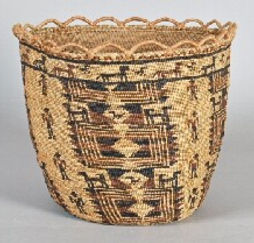
Basket (c. 1800s)
Skokomish Reservation, Washington
Burke Museum, Seattle
Every few newsletters, I like to play a game of “guess that breed” but occasionally, the breed is obvious. While many of the artworks we look at can have generic dogs with unidentifiable breeds, sometimes we can make guesses on what breeds they could be based on physical characteristics and locations. This time, while the characteristics may imply a generic dog, textual and oral evidence points to a very specific breed.
The basket itself has been identified as having most likely been made by members of the Skokomish Tribe. There are many intricate twined designs that are unique to the Skokomish people which is how we can identify this basket. Their baskets are often made out of cedar bark, grass, and cattail leaf and often are tightly woven. Many baskets also have figures important to Skokomish life on them. This basket has the tightly woven designs common amongst Skokomish baskets and has four different types of figures. Around the top of the basket are wolves, which are identified by their tails, which are pointed down. This is different from the pet dogs which are on the body of the basket and have tails that curve up. There are also people on the basket in between the dogs. Finally, we have the puppies which are the smaller dogs inside of the diamonds. These diamonds represent what we today call the “whelping box” a box with low to the ground sides that allow for the mother dog to get in and out as needed while keeping the puppies inside.

Reconstruction of the woolly dog based on Mutton's pelt as well as archaeological remains by Karen Carr
The dogs and puppies on this basket are believed to be the Coast Salish Woolly Dog, a very important dog to many Coast Salish people. The Woolly Dog is an unfortunately extinct breed that was bred by the Coast Salish people for their white, thick, and long fur. This fur was similar in texture to goats’ and was used in weaving and knitting. In an area that had no sheep and only had wild mountain goats around, having a consistent, domesticated source of high-quality fiber was important. In some communities, only the most honored women were allowed to choose which dogs to breed in order to keep the fur white, soft, and long. While there is a lot of textual and oral evidence of the Coast Salish Woolly Dog, Mutton is the only known specimen still around. Mutton belonged to ethnographer George Gibbs who, after Mutton passed away, sent him to the Smithsonian Institution sometime in the early 1860s. Mutton’s pelt stayed there, unknown, until 2002, when historian Candace Wellman from Bellingham, Washington, found letters between ethnographer C. B. R. Kennerly and a member of the Smithsonian. In the letter, Kennerly wrote about a mountain goat skin that Gibbs’ had sent him, one whose head had been eaten by Mutton. At the end of the letter, Kennerly wrote “Mutton was sheared a short time ago, & as soon as his hair grows out we will make a specimen of him.” However, it’s most likely that this threat was mostly empty as letters from Gibbs mentions Mutton getting sick soon before his believed death date. Most likely, he was made a specimen after his death from natural causes. After finding this letter, Wellman wrote to the Smithsonian where they confirmed that Mutton was still around in the collections. In 2020, evolutionary biologist Audrey Lin, studied Mutton’s DNA. Through this study, they found that Mutton had a great-grandparent who had been a European dog but the other 85% was completely woolly dog.

Mutton the Coast Salish Woolly Dog, 1859
Coastal Washington, possibly Chiloweyuck Depot
National Museum of Natural History, Washington D.C.
In the 1800s, as colonialism spread, many Coast Salish traditions were eradicated. Strict reproductive isolation for the woolly dog was one of them. Many Coast Salish people would keep their woolly dogs on small islands, away from the hunting dogs, visiting them at least twice a day to feed and play with them. Keeping them on these islands allowed the recessive traits that caused their prized fur to remain. The United States government forced many people to give up their dogs and those that remained bred with the European dogs until the Coast Salish Woolly Dog was no longer around. However, in recent generations, many Coast Salish people have been bringing their traditions back. Chief Janice George has worked hard to resurrect the art of weaving in the Squamish Nation and Michael Pavel, an elder from the Skokomish/ Twana Coast Salish community, has helped to keep the stories of the Coast Salish Woolly Dog alive. In writing about the dogs in an article for the Smithsonian, Pavel said, “They were loved, they were embraced and in return, they showed us unconditional love. They showed us loyalty and a zeal for life.”
I would recommend checking out The Teachings of Mutton by Liz Hammond-Kaarremaa (link above) if you want to learn more about the Coast Salish Woolly Dog. Also, if you're in the Seattle area, check out Burke's new exhibit on Coast Salish Weaving. It should be there until next fall and it's absolutely worth a look!
10/12/2025- Three Round Puppies

Three Young Puppies, 1826 (Printed Posthumously)
Nakamura Hôchû (? – 1819, Japanese)
Rijksmuseum, Amsterdam, Netherlands
This week’s dogs are one of my favorites! Nakamura Hôchû’s “Three Young Puppies” shows three sleeping, very round, puppies, most likely around 3 weeks old. Nakamura Hôchû lived and worked in the late Edo Period (1600-1868), mostly in Osaka in Southern Japan. Not much is known about his life. Historians believe that he might have come from a wealthy merchant family due to education and his interactions with literary scholars. By 1790, Hôchû was an established artist appearing in written materials from that time. His most famous work, published in 1802, was a book called “Korin Gafu” (“A Book of Pictures by Korin” or “Korin Picture Album”). While the name would imply that the book was a collection of pictures by Ogata Kōrin, one of the creators of the Rinpa school of painting, the paintings were actually all done by Hôchû in the style of Korin. For three years before this book came out, Hôchû devoted himself to the study of Korin’s paintings, specifically his tarashikomi technique. Tarashikomi is a way of dripping and puddling a second layer of ink/ colors on paper or metal foils while the first layer is still wet. This brings about variegated chromatin effects and gradations which can be seen a little bit in Three Young Puppies, specifically on the black puppy. These art books, called “ehon” were very common in the Edo period and often showed scenes of daily life. Hôchû’s book, however, was different in that he added a playful and spontaneous touch to the artwork, making them more accessible and dynamic. “Three Young Puppies” is a good example of this and shows how he respected the traditional art style while simultaneously making it more fun. While dogs are incredibly common in art, puppies are less so. When artists include dogs in their work, they almost always do so with a purpose. Dogs in art often represent loyalty, friendship, or companionship. In other cultures, dogs can represent the underworld, hunting, or even wealth. Most interestingly, some artists include dogs in their art simply because they like dogs. Sometimes they include their own dog, or a childhood dog, for their own enjoyment. Or sometimes they include a dog for the audiences’ joy. Since so little is known about Hôchû, we don’t know what he thought of dogs. These might have been puppies he knew or puppies he saw on the street and was inspired. Or maybe he just enjoyed their fun roundness.
10/05/2025- Cylinder Dogs

Cylinder Seal (2400 BCE - 2200 BCE)
Akkadian Empire
The British Museum, London
Today’s dogs are found on a cylinder seal from the Akkadian Empire. The Akkadian Empire is believed to have been one of the first ever empires and existed between c. 2334 BCE and 2154 BCE making this cylinder over 4000 years old! Cylinder seals, such as this one, are usually about 1 inch in diameter and are often made out of semi-precious stones. This cylinder has a diameter of 1.06 inches (2.75cm) and is made out of dark green serpentinite aka serpentine. Serpentinite is a type of rock that is very easily carved and has been used in artwork all over the world including Greece, Germany, and the Arctic. Cylinder seals were often used as an administrative tool, a signature, or for ancient product branding. They were also often included as honorific grave goods. Imagine having a stamp so meaningful that you’re buried with it!
The images on the seals, especially during the Akkadian Empire, were often religious. This one most likely shows the ascent to heaven of Etana. Etana was a Sumerian king that supposedly ruled in 2800 BCE. However, many of the earliest Sumerian kings are generally believed to have been myths and not real kings, including Etana. One of the reasons historians believe Etana was more of a mythological figure is because he supposedly ruled for 1500 years and then his son ruled for 400 years. The story of how Etana got his son is also quite mythological. According to Babylonian legend, there once was a tree that had an eagle’s nest at the top and a serpent at the base. They both promised the sun god, Utu, to behave well toward one another until one day the eagle eats the serpent’s children. The serpent cries to Utu who tells the serpent to hide inside the stomach of a dead bull. When the eagle goes down to eat the bull, the serpent captures the eagle and throws him into a pit to die of hunger and thirst (unclear why the eagle can’t just fly out). Utu then sends Etana to help the eagle. Etana saves the eagle and in return asks the bird to help him find the “plant of birth” so that he can be father to a son. The eagle takes him to the heavens to find it. But what does this have to do with dogs? In all truth, I’m not sure. The cylinder seal appears to show a similar story but with lions instead of a serpent. On the left shows two lions at the base of a tree and an eagle in the branches of the tree. The eagle appears to have a small animal (a lion cub?) in his right talon. On the right appears to be another eagle carrying a man, possibly Etana, while two seated dogs bark in the direction of the eagle. The dogs have pointy ears, long tails, and are doing a great job at sitting! The middle part appears to be slightly unrelated. On the left, next to the tree appears to be a shepherd leading his flock with another shepherd behind them. Above the sheep are a couple other people performing tasks. One appears to be churning something, another is kneeling in front of a rectangle, and the last one may be pouring something into cheese molds. Perhaps this middle part is showing the process of Mesopotamian cheese making, from sheep to molding? Modern historians are unsure what the connection is between Etana and the shepherds
The story depicted on this cylinder seal is more or less unintelligible to a modern audience. We don’t know for sure the meanings behind the lions, the goats, or the dogs. We know that dogs were used to help protect the sheep herds and their people so it’s possible that these dogs are related to the sheep next to them. It’s also possible that this cylinder has nothing to do with Etana at all. However, there have been cylinder seals with similar pictures, sheep cheese and all, found in other areas that most historians agree depict the myth of Etana so it most likely is. Maybe we’ll find out one day what cheese and dogs have to do with the myth of Etana but in the meantime, the pups remain a fun historical find. Once again, here is a depiction of ancient dogs acting the same as modern dogs do, barking at things they probably shouldn’t be. So the next time your dog is barking at a bird, maybe they’re just remembering their Sumarian ancestors!
9/28/2025- Presidential Pets Part 2

Kennedy Family with Dogs in Hyannis Port, Massachusetts
Cecil Stoughton (American, 1920-2008)
John F. Kennedy Presidential Library and Museum
Dogs were also often given to presidents as gifts. Outside of Checkers, one of the most famous presidential gifts was Pushinka, a mixed breed given by the Soviet Premier Nikita Khrushchev to President John F. Kennedy in 1961. Pushinka was the daughter of Strelka, the first dog (along with another dog named Belka) to orbit Earth and return alive. At a state dinner in Vienna in early 1961, Jacqueline Kennedy had spoken to Khrushchev about Strelka and asked about her puppies. Pushinka was subsequently sent to the White House. Since it was the middle of the Cold War, Pushinka was examined by the CIA and, after being x-rayed, screened with a magnetometer, and inspected by sonogram, was found to be free of listening devices. Pushinka enjoyed her life at the White House and in 1963 had 4 puppies with one of the Kennedys’ other dogs, Charlie. The kids, Caroline and John Jr. named the puppies Butterfly, Streaker, Blackie, and White Tips. The president jokingly referred to these puppies as “the pupniks”. Throughout Kennedy’s presidency he regularly exchanged letters with Khrushchev, including one that thanked him for Pushinka writing “Mrs. Kennedy and I were particularly pleased to receive ‘Pushinka’. Her flight from the Soviet Union to the United States was not as dramatic as the flight of her mother, nevertheless, it was a long voyage and she stood it well. We both appreciate your remembering these matters in your busy life.” Khrushchev’s son, Sergei, later interviewed about this exchange, recognized that his father “thought it would be pleasant for the family and good for politics”. Pushinka’s delivery was, mostly, a political move. Less than 2 years after Pushinka came to live in the White House was one of the most stressful moments in the whole Cold War, the Cuban Missile Crisis. Modern historians recognize that communication between the two leaders, including gifts such as Pushinka, had a huge impact on the outcome of the Cuban Missile Crisis. As of 2024, descendants of Pushinka are still living elsewhere in the United States.

Johnson Family with Dogs in the Rose Garden, 1966
Photographer not currently known
The White House Historical Association
However, not all presidential pups were good PR for the president. From Teddy Roosevelt to Joe Biden, many presidents have had dogs who got in trouble for biting people. Lyndon B. Johnson got into big trouble when, in 1964, a photo was published in Life magazine that showed LBJ picking his beagle, named “Him”, up by the ears. Hundreds of phone calls, telegrams, and letters came in from angry dog lovers, including members of the ASPCA. While Johnson did give a public apology, privately he was confused at the controversy. Having grown up around hunting dogs, this was the first time he had been told that maybe pulling dogs by their ears wasn’t a great idea. In recent years, groups such as the American Kennel Club recognize that, while grabbing dogs’ ears is no longer considered best practice when it comes to handling animals, Johnson really did love his dogs and did not do it to hurt Him.
Him, and his sister “Her”, were not the only dogs that Johnson had in the White House, however. Johnson loved beagles and had several. Outside of Him and Her, there was also Freckles and Kim, puppies sired by Him. Freckles also had a litter of puppies which included, Little Chap, Dumpling, and Bo. After Him died in 1966, J. Edger Hoover (yes, that J. Edgar Hoover) gave LBJ another beagle, who he named J. Edgar. Later, they dropped the “J.” and just started calling him “Edgar”. LBJ also had a beagle named “Little Beagle”. Archivists at the Lyndon B. Johnson Presidential Library has a “cheat sheet” that they use to keep track of which beagle is which in photos. Outside of Beagles, Johnson also had 2 non-beagles. There was Blanco, a white collie, and Yuki, a mixed breed dog found by Johnson’s daughter Luci at a gas station. While Yuki lived with Luci at first, he quickly became a favorite of LBJ. Yuki and the president would “sing” together, mostly consisting of them both howling. And Yuki sat in on meetings in the Oval Office and bill signings. After LBJ left office in 1969, all of the dogs moved back with him to the LBJ ranch, other than Freckles, who went to live with a White House staff member, and Blanco who moved to Kentucky with a friend of the Johnson family.

President Ford and Liberty in the Oval Office
Bruce Dale (American)
The White House Historical Association
Liberty, Gerald Ford’s Golden Retriever, was one of many dogs that gave birth in the White House. Born in Mount Vernon, Washington, she was given to Ford in the fall of 1974, only a couple months after he became president. Liberty was often photographed with Ford in the Oval Office and on the White House Lawn. One morning, Ford was locked in a White House stairwell after returning from walking Liberty early in the morning! Ford also trained Liberty to help him diplomatically in the Oval Office. He would signal the pup who would then approach the guest while wagging her tail, creating a natural break. At a dinner in 1974, Ford discussed Liberty,
“This puppy has really taken over the White House. In fact, you may have seen some of us laughing up here during dinner. As I reached in my pocket to get a match to light my pipe, look what I pulled out of the pocket — some dog biscuits!” He then told the story about how his daughter Susan and the White House photographer David Hume Kennerly, visited the breeder in Washington to get a golden retriever. The breeder was a little cautious and wanted to know who the dog’s owner was going to be. Susan and David said that it was a secret and the kennel owner refused to sell them a pup unless he could confirm she would be going to a good home.
“So, Dave and Susan very specifically assured the dog owner that it would have a good home. They explained that the parents were friendly and middle-aged and they had four children. The kennel owner said, "That sounds fine. What kind of a house do they live in?"
Susan and Dave said, "Well, it is a big white house with a fence around it." The kennel owner said, "This is a big dog. Will it have enough to eat? Does the father have a steady job?" Well, on that question, they were stuck a bit. [Laughter]
Needless to say they got the dog and, in the appropriate spirit of the city of Philadelphia, we have named her "Liberty." One of those inquisitive reporters that we have in Washington asked Susan who is going to take care of Liberty; who is going to feed her and groom her and take her out each night or every morning? And Susan did not hesitate one minute. She said, "Of course, it will be Dad." So, I have this feeling — this is one Liberty that is going to cost me some of mine.
But in a very broader sense, that is the true nature of liberty. It comes with both privileges and obligations. Freedom, we all know, is seldom free.”
Like many presidential pups, Liberty was simultaneously good publicity, and someone the president (most likely) genuinely cared for.

President Bush, Millie, and Puppies on the South Lawn of the White House
Michael Sargent
White House Historical Association
While many presidential pups have given birth in the White House, Millie and Spot were special. Millie belonged to president George H. W. Bush and her daughter, Spot, belonged to Bush’s son George W. Bush!
Mildred “Millie” Kerr Bush has been referred to as “the most famous dog in White House history” and while that may not be true, she’s certainly the most famous dog of the 1990s. In 1990, Millie was credited as the author of “Millie’s Book: As Dictated to Barbara Bush” which was a “dog’s-eye perspective on behind-the-scenes goings-on at the Bush White House”. Like many presidential pups before her, Millie was also mentioned during Bush’s 1992 bid for re-election when he said “My dog Millie knows more about foreign affairs than these two bozos” in reference to Bill Clinton and Al Gore. (Editors Note: It is believed that Millie also knew more about foreign affairs than Bush.)

President George W. Bush Walks Across South Lawn with Barney
Photographer not currently known
White House Historical Association
In 1989, Millie gave birth to a litter of six puppies which included Spot “Spotty” Fletcher. Spotty was born in the White House and was given to Bush’s son, Bush II. While less famous than her mother, Spotty is the only presidential pet to have lived in the White House under two presidents. Bush II had another dog named Barney, a Scottish Terrier appears in the above photo. Barney was incredibly well known, having appeared in eleven government film productions and having his own official web page.

President George W. Bush Walks Across South Lawn with Barney
Photographer not currently known
White House Historical Association
Millie is not the only dog to have her own book. Buddy Clinton features heavily in Hillary Clinton’s book “Dear Socks, Dear Buddy: Kids’ Letters to the First Pets”. Socks was the Clinton’s other pet, a cat who they adopted after he jumped into the arms of Chelsea Clinton as she was leaving the house of her piano teacher. Buddy and Socks did not get along and when the Clintons left the White House, Socks moved in with Clinton’s secretary. Buddy was a chocolate lab who the Clintons adopted when he was a 3-month old puppy in 1997. Like many pups before him, Buddy was good friends with the president and accompanied him around the Oval Office and on walks on the White House grounds. Buddy is the first presidential dog to have his own webpage, both an official White House page and lots of fan websites created in the early days of the internet. Hillary Clinton wrote about her transition to becoming first lady, “it wasn’t until Socks arrived with his toy mouse and Buddy walked in with his rawhide bone that this house [the White House] became a home. Pets have a way of doing that.”

President George W. Bush Walks Across South Lawn with Barney
Photographer not currently known
White House Historical Association
Bo and Sunny were both Portuguese Water Dogs owned by the Obamas while they were in Office. After months of speculation by the media, it was announced that the Portuguese Water Dog had been chosen by the presidential family for its hypoallergenic nature since Malia Obama was allergic to dogs. In April of 2009, it was announced that Bo would be joining the Obama family. The dog had reportedly visited the family some weeks earlier in a secret meeting to gauge compatibility referred to by staffers as “The Meeting”. Immediately after he arrived at the White House he was given a lei (referring to Obama’s Hawaiian background) and photographed by the media on the South Lawn. In 2009, the White House released a baseball card for Bo with his new official portrait on one side and fun “statistics” on the other. Info included Bo’s favorite food (tomatoes) and that he didn’t yet know how to swim. Their second dog, Sunny, is also a Portuguese Water Dog, born in 2012, she joined the family sometime before August 2013, when her addition was announced.
For all of known history (and most of unknown history too), dogs have brought people together and the presidential pups are no different. While often used to make the president look good in front of constituents, most of these dogs were also genuine friends to their owners. When Bo Obama passed away in 2021, Eileen Vorbach Collins (an author who often writes about loss) wrote this poem about him:
Elegy for Bo
Canus familiaris in chief
Of the United States
Served his family and his nation
With loyalty and grace
White blaze on black fur
A symbol of unity—a wish
Like ebony and ivory
In Stevie Wonder’s song
Footballs on the lawn
Greeting the Pope
Storytime in Michelle’s lap
He showed us the humanity
Still possible in our politics
Welcomed Sunny to the family
Shared his toys and his title
Greeted Melia and Sasha
Home from school
Knowing it wasn’t easy
To be a child in the White House
If Norman Rockwell were alive
He’d paint those scenes
And we would call it America

President Barack Obama with Bo, 2012
Pete Souza
White House Historical Association
It’s important to mention that I’m not writing this to put any one president on a pedestal. As much as I try to keep things politically “neutral” (whatever that can mean), discussing these dogs will always be inherently political because of their relation to the president. I don’t want to pretend that these presidents I’ve discussed are amazing and wonderful for having dogs or that having a pup means they’re inherently kind. But there’s a reason having a dog usually leads to good PR, because dogs connect us as humans. In the end, though, this newsletter is not that deep. I love dogs, regardless of (and usually in spite of) their owners and I find it fun to talk about famous dogs. And I enjoy seeing dogs acting like dogs always do. While fame and power often, if not always, changes humans; the dogs stay the same. That's why we love them.

President Johnson Sings with Yuki in the Oval Office, 1968
Yoichi R. Okamoto (American, 1915-1985)
White House Historical Association
9/21/2025- Presidential Pets Part 1

Dog Vest, 1950s
Used in the United States
National Museum of American History, Washington D.C.
On Tuesday, September 23, there is a fun holiday I did not know about until recently. National Dogs in Politics Day celebrates all the political canines out there. While all the dog mayors and dog CEOs out there are also celebrated on this day, the day specifically celebrates the dogs in the White House. The holiday has fascinating beginnings. In 1952 (20 years before Watergate), Senator Richard Nixon, running for Vice President with Eisenhower as President, was accused of misusing campaign contributions. In the speech, Nixon denied using campaign donations for personal use (which, at the time, was true) with one exception. In what would become the most famous lines of the speech, Nixon brings up a dog his family had been gifted by a supporter, a “little cocker spaniel dog” which they named Checkers, and states that they intend to keep the dog. The speech, one of the first to use television as its medium, was a hit and became forever known as the “Checkers Speech”. To this day, “Checkers speech” has come to mean a personal, emotionally charged speech given by a politician in order to win support from the public. However, this was not the first time a politician was accused of misusing money for their dogs.

Franklin Roosevelt and Fala at the Resolute Desk, ca. 1941
Photographer not currently known
The White House Historical Association
The “Checkers speech” was partially inspired by Franklin D. Roosevelt’s “Fala speech”. Fala was born in 1940 and was given to Roosevelt as a Christmas present. When he first arrived at the White House, Fala had to be taken to the hospital for intestinal problems. Roosevelt found out that Fala had found his way to the kitchen and was being overfed by staff. He then had to issue an order that Fala could only be fed by the president himself. Fala also accompanied the president to important events. In 1944, the two visited the Aleutian Islands. When they returned, rumors began to circulate that Fala had been accidentally left behind and the president sent a U.S. Navy destroyer to retrieve him at an exorbitant cost to the taxpayers. Roosevelt addressed the rumors in a speech at a dinner with the International Teamsters Union.
These Republican leaders have not been content with attacks on me, or my wife, or on my sons. No, not content with that, they now include my little dog, Fala. Well, of course, I don't resent attacks, and my family don't resent attacks, but Fala does resent them. You know, Fala is Scotch, and being a Scottie, as soon as he learned that the Republican fiction writers in Congress and out had concocted a story that I'd left him behind on an Aleutian island and had sent a destroyer back to find him – at a cost to the taxpayers of two or three, or eight or twenty million dollars – his Scotch soul was furious. He has not been the same dog since. I am accustomed to hearing malicious falsehoods about myself ... But I think I have a right to resent, to object, to libelous statements about my dog.
The audience found this speech hilarious and it assured his 1944 reelection (although post-WWII it was likely he would’ve been elected anyways). While FDR was reelected, he would pass away the next year. Fala attended his funeral and then became the "inseparable companion” of Eleanor Roosevelt. When Fala passed, seven years later, he was buried 10 yards behind Roosevelt, besides Roosevelt’s other dog Chief.

Fido, dog of Abraham Lincoln, 1860
F.W. Ingmire (American, 1822-1876)
Abraham Lincoln Presidential Library and Museum
While U.S. Presidents have had a wide variety of pets, from cats to silkworms (John Quincy Adams kept silkworms whose silk the First Lady spun), dogs are possibly the most popular pet with 33 out of the 45 presidents having had dogs in the White House. This week’s newsletter (which might get a little long, whoops) will go through a handful of those presidential dogs to celebrate National Dogs in Politics Day. The first president to have dogs was George Washington (he kept several hunting dogs) but the first president to have his dog photographed was Abraham Lincoln. Fido was a yellow mixed-breed dog belonging to the Lincoln family. He was a friendly dog but was frightened by loud noises and so stayed in Springfield, Illinois as the rest of the family went to Washington D.C.. Left in the care of a family friend, Lincoln left instructions that Fido be allowed to have the run of the house, not be scolded for tracking mud, and to be allowed to wander around the family dinner table and be fed scraps. Lincoln also left Fido with an old sofa that was a favorite of Fido’s. Unfortunately, this would be the last time Fido saw Lincoln as he was assassinated before he could come back to Springfield. Like Fala, Fido was brought to Lincoln’s funeral. And if you were wondering, the name Fido became a generic name for a dog because of the popularity of Lincoln’s pet!

Grace Coolidge with White Collie Rob Roy, 1924
Howard Chanler Christy (American, 1872-1952)
White House Historical Association
While Fido was the first presidential pet to be photographed, the first presidential pup to be included in an official portrait was Rob Roy, a white Collie belonging to Calvin and Grace Coolidge. The Coolidges kept many pets including birds, cats, and even a raccoon, but Rob Roy was Calvin’s favorite. Rob Roy joined the family in 1922, the year before Calvin Coolidge became president. Coolidge described Rob Roy as a “stately gentleman of great courage and fidelity” and he was known to lead Coolidge to the Oval Office each morning. Rob Roy was also perhaps the first presidential dog to watch films as Coolidge was known to try and trick Rob Roy into chasing animals that appeared on screen during White House showings. According to Harry Truman, Coolidge also once ordered Senator Morris Sheppard to “surrender his sausage” to Rob Roy while the three of them were having a late lunch. This portrait of Grace and Rob was painted in 1924 by Howard Chanler Christy as Grace Coolidge’s official White House portrait. Rob’s pose was achieved by Grace feeding him candy throughout the portrait sittings. While originally hung in the Red Room of the White House, it currently hangs in the China Room.

Theodore Roosevelt and St. Bernard, Rollo, ca. 1906
Photographer not currently known
White House Historical Association
The president with the most pets though? That would be Theodore Roosevelt. At the White House, he had (takes a deep breath) 5 guinea pigs, 3 horses, 2 cats, 1 rabbit, 1 pig, 2 chickens, 1 owl, 1 lizard, 1 snake, 1 macaw, 1 rat, 1 badger, 1 black bear (eventually sent to the Bronx Zoo), 1 hyena (a gift from Emperor Menelik II of Ethiopia), and 9 dogs. He also had six children who loved to take care of the many pets. His favorite was a dog named Pete who was eventually exiled from the White House after two separate incidents in which he tore off the pants of the Secretary of the Interior and later tore the pants off of the Ambassador of France. There’s not a lot of evidence about his St. Bernard, Rollo, although that’s probably due to the chill nature of St. Bernards.

President Hoover with King Tut, ca. 1929
Theodor Horydczak (Polish-American, 1889-1971)
White House Historical Association
One of the earliest instances of a pet featuring in a presidential election was Herbert Hoover’s Belgian Malinois named King Tut. The Hoovers got the dog in 1922 and was most likely named after King Tutenkhamen as the opening of his tomb that same year made the name incredibly popular. In 1928, autographed pictures of Hoover with his pup were distributed amongst voters in an attempt to make Hoover seem more personable during the 1928 presidential campaign. The dog moved in with them in the White House but was supposedly unhappy so he was moved back to their former house in Connecticut.
9/14/2025- Conversation Piece

Conversation Piece at the Royal Lodge, Windsor, 1950
Sir James Gunn (1893 – 1964, English)
National Portrait Gallery, London
One of the most famous dog lovers of the modern era is the late Queen Elizabeth II. Known for her corgis and “dorgis” (a dachshund/ corgi mix) that have appeared in statues, cartoons, a movie, and even on a coin, Queen Elizabeth II has had owned over 30 corgis during her lifetime, most of them descendants of Susan, a corgi given to her on her 18th birthday. She first fell in love with corgis when she was seven years old. Her family visited Thomas Thynne, the Marquess of Bath who owned corgis, uncommon at the time. Soon afterwards, the family got their first corgi, who Elizabeth named Dookie in honor of her father, the (at the time) Duke of York. Three years later, they bought Dookie’s sister, Lady Jane, who had two puppies, Carol and Crackers. Crackers became the dog of The Queen Mother and retired with her to Scotland. During this time, The Queen Mother also introduced a disciplined regimen for the dogs, each had its own bed (raised above the floor to avoid draughts), they got biscuits in the morning and dog food with gravy in the evening with no snacks of human food. They did get extra biscuits for celebrations and rewards. When Elizabeth II turned 18, she was gifted Susan who came with her on her honeymoon two years later (this fact was unfortunately not included in The Crown). Susan even was with Elizabeth at her wedding, hidden under the rugs of her carriage as the newly married couple rode through London. She had two puppies from her first mating, Sugar and Honey. Honey became the Queen Mother’s after Crackers and Sugar became the nursery pet of Prince Charles and Princess Anne. From then on, Queen Elizabeth was never without a corgi, almost all of them descended from Susan. At some point, one of Susan’s descendants mated with one of Princess Margaret’s dachshunds, a pup named Pipkin which resulted in the first royal dorgi. They would later breed more dorgis. In 2007, Queen Elizabeth II had 14 dogs, five corgis (Monty, Emma, Linnett, Willow, and Holly); five cocker spaniels (Bisto, Oxo, Flash, Spick, and Span); and four dorgis (Cider, Berry, Vulcan, and Candy). Candy was the last of Susan’s royal line as the Queen stopped breeding corgis in 2012. However, that doesn’t mean that she didn’t have any corgis as family gave her several dogs in the years between her decision to stop breeding corgis and her death 10 years later. After she died the corgis went to Elizabeth’s son, Prince Andrew and currently live in the Royal Lodge on the Windsor Estate. The corgis that have died are buried at the royal residence, Sandringham estate in Norfolk, a pet graveyard first used by Queen Victoria in 1887.
This painting shows the Royal Family as it was in 1950: King George VI, Queen Elizabeth (The Queen Mother), Princess Elizabeth, and Princess Margaret. The Royal Family commissioned the portrait as a statement of stability and security following WWII. The informality of the portrait was entirely new. The family sits around the table for tea time, King George’s dog behind him. The painting could almost be taken for any 1950s family, albeit a wealthy one. Painted in 1950, Elizabeth was 24 and married with two children. She would have already had Susan and most likely Sugar and Honey as well, although we don’t know their exact birthdates. However, the dog in this painting is most likely none of those. Seeing as the pup was placed behind the King, this one most likely belongs to him. The King owned at least eight dogs throughout Elizabeth’s childhood, it’s unknown how many of them were corgis though. The dog in the painting is referred to as a corgi on the museum’s webpage so most likely, this is one of Lady Jane’s offspring, Carol or Crackers, as Dookie was born in 1933 and had most likely passed by the time of this portrait. As with most other pieces of art, adding a dog brings about an air of familiarity to the viewer. A dog can be a connection between classes, between nations, between people so it’s unsurprising that a post-war Royal Family would want to include their pet as well. Sir James Gunn, the artist of this painting, has mentioned that he had difficulty placing the corgi, moving it about on the canvas as a paper cut-out. I think where he eventually put the dog works very well. As they say, behind every great King is an even greater Dog.
9/07/2025- Green Glazed Dog

Green-Glazed Pottery Dog (Eastern Han Dynasty; 25 CE - 220 CE)
China
Shanghai Museum (上海博物馆)
This week’s object is another case of “what kind of dog is that?” Unfortunately, it is a little hard to figure out a lot of information about the statue since this item comes from the Shanghai Museum in China and I cannot read Chinese. Through Google Translate, I was able to find that this dog comes from the Eastern Han Dynasty and is made out of pottery. The Green-Glazed Dog has pointed ears and a curled tail. He is also wearing a decorated harness.
The Eastern Han Dynasty is the second part of the Han Dynasty which spanned from 25 CE to 220 CE. During this time, dog figurines similar to this one were often buried with the dead in their tombs. There are several examples of green-glazed pottery dogs with a decorated harness, throughout museums in China. This dog is special because of the completeness of the statue and the dark pigmentation of the glaze; many similar statues are currently faded. The decorated harness/ collar indicates that this dog was domesticated as a pet. It’s unknown whether this dog represented a specific pet of the person it was buried with or the person’s general love of dogs. During the Eastern Han Dynasty, artwork began being made for tombs exclusively for burial and dogs, along with farms that included sheep, pigs, chickens, and ducks, were very common. While the Han Chinese did eat dogs, these dogs were bred specifically for food while others were used as pets. The Emperor also kept hunting dogs during this time.
There are two types of modern day dog that could be descendants of this dog: the Shar Pei and the Chow Chow. The ancient Chow Chow ancestor originated in central China about 8,300 years ago. This breed is known for their sturdy build, small triangular ears, curled tail, and very thick fur coat. The most distinctive feature of the Chow Chow is its blue/black tongue. In the 13th century, Marco Polo remarked that the Chinese used these dogs to pull sleds through swampy terrain. Chow Chows also have a slightly squished muzzle that has become more squished over time.
The Shar Pei’s ancestors date back to at least the Han Dynasty and were very popular in China until the 20th century. Because of war and political turmoil in China, by 1970, the breed was close to extinction. Then, in 1973, a Hong Kong businessman named Matgo Law appealed to the international community to help save the breed. This led to great demand in the United States and elsewhere for Shar Peis which brought them back from extinction, but with a bit of a catch. Due to the popularity of the breed, unscrupulous breeders began crossing the Shar Pei with other dogs such as the bull terrier, pug, and bulldog, to increase the amount of dogs they could breed. They then would sell this mixed breed off as a purebred. These crossings resulted in a dog with more wrinkles on the face and a “fleshier mouth”. These dogs became known as “wrinkle-mouth” or “meat-mouth” Shar Peis while the original dogs are called “bone-mouth” Shar Peis. When the breed was recognized by the American Kennel Club in 1992, they specified the breed standard was the “wrinkle-mouth” type since that type had become the dominant feature of the breed.
Both of these dogs are a great example of how hard it can be to identify any art before 1900 using modern-day breed characteristics. Both the Shar Pei and the Chow Chow have more wrinkles on the face and more exaggerated features than the dogs of the Eastern Han Dynasty. So what type of dog is this object? Well, it’s also possible that the answer is both of them. The Chow Chow and the Shar Pei both are incredibly similar in looks and have very similar ancestry, both dogs are one of the only breeds with blue/ black tongues! Some historians believe that both of these dogs descended from the same ancestors, the only difference being that one dog was bred to have a longer coat, and one was bred to have a shorter coat. On one hand, that’s a very unsatisfying answer. I like to think that the dog above more closely resembles the Shar Pei since it’s missing the very thick coat of the Chow Chow. But if I’m being a good academic, I have to recognize that it’s hard and often impossible to label the past with our modern day labels, even if that leads to an unsatisfactory ending.
8/24/2025- Captain Lord George Graham

Captain Lord George Graham, 1715-47, in his Cabin, 1745
William Hogarth (1697 – 1764, English)
National Maritime Museum, Greenwich, London
Captain Lord George Graham (1715-1745) was a Scottish officer of the Royal Navy who saw service during the War of the Austrian Succession. He later became a Member of Parliament, partially due to the influence of his father. When he was 29, he was appointed to the HMS Cumberland but turned it down to instead command an active cruising ship, the HMS Bridgewater. On July 2, he came across three French privateers (basically pirates for the French/ another country who raids the ships of the country they’re at war with) and defeated them. For his success in the engagement, Graham was given command of a larger ship the HMS Nottingham. To celebrate, Graham commissioned William Hogarth to paint a scene of him celebrating in the cabin of the Nottingham. Cabin scenes in oil are rare and this painting is considered by some historians to be the most famous cabin scene in British art.
Graham is seated on the right, with a red cloak around him. Sitting around the table with him are the ship’s chaplain and clerk. The three men are listening to one servant play music for them while another brings a roast duck to the table. The men are well dressed, Graham wears a red, fur-lined cloak and a green, slightly askew, velvet hat, making him more well dressed than the others. The mood of the painting is generally one of brevity and joy. The men are singing and enjoying music and at the floor by the chaplain’s feet is a punch bowl, perhaps the reason why they seem so merry.
Most interesting, at least to this audience, are the two dogs in the painting. One dog, Graham’s spaniel, sits across from him, at the chaplain’s feet, joining in the singing. The other is a pug wearing Graham’s wig and appearing to read from his own music sheet. This dog is Hogarth’s dog, unfortunately named (to our modern viewers at least) Trump. Trump appears in at least seven other works, from his appearance as a puppy in Hogarth’s “The Fountaine Family” to him as an old man in the self-portrait “Painter and his Pug” done the same year. While he may not look like the modern pug, Trump is a pug nonetheless. Pugs have roots dating back to 400 BCE in China. There they were called Lo-Chiang-Sze which referred to a short-legged, short-mouthed, short-coated dog, differentiating them from the Peikingese which had a long coat. The Lo-Sze was brought to Europe in the 1500s by the Dutch East India Company where they quickly became popular at European courts. In 1572, pugs became the official dog of the House of Orange after a pug named Pompey saved the life of the Prince of Orange by alerting him to approaching assassins. By the mid-1700s, pugs were incredibly popular. Author Hester Piozzi wrote in her journal “Every carriage I meet here [Italy] has a Pug in it.” In the early-1800s, there were two lines of pugs in Europe, the Morrison and Willoughby lines. The Morrison pug was more similar to what we know of as a “pug” today while the Willoughby line had more black on their heads and had a longer face. The pug, as we know them today, changed after 1860, when French and British soldiers stole a new wave of pugs from the Old Summer Palace as it was being razed. These dogs were “identical in every respect with the Pekingese Spaniel, except that his coat is short and smooth”, aka their noses were more squished than the contemporary pugs of Europe. These new pugs were then bred to pugs of both the Willoughby and Morrison lines which merged both strains. As pugs continued to be bred over the next 150-ish years, their muzzles and legs became shorter and shorter leading to many health problems. Since 2006, some people have begun to breed “retro pugs” which would lead to healthier dogs that look more like the pugs of the past.
William Hogarth owned several pugs throughout his life, although Trump was probably his most painted and most famous. He was so well known for his love of pugs that he was disparagingly nicknamed the “Painter Pugg” (yes with 2 g’s). However, Hogarth ignored this nickname and continued to use the dog in his paintings and engravings. In 2001, a statue of Hogarth with his dog, Trump, was unveiled in the Chiswick district of London near where Hogarth and Trump once lived.
In the painting of Captain Lord George Graham, the dog wearing Graham’s wig could be considered making fun of him. However, Graham supposedly enjoyed the painting and it remained in his family until 1932. It’s possible that, instead of making fun of Graham, the painting is supposed to make fun of the Royal Navy. This ship being painted was one that Graham didn’t want at first. He was appointed to command the 60-gun Cumberland at first but preferred the smaller 24-gun Bridgewater. When he won the skirmish and brought British ships back from the French privateers, he was rewarded with… a different 60-gun ship. Now, is it possible that his tastes changed after some time on the Bridgewater? Absolutely. Is it also possible that he was given a gift he did not want? Also, yes. The wig the pug wears is not just Graham’s wig but Graham’s wig for his position as a Member of Parliament. While these long, curled wigs were falling out of favor by 1745, they were still worn in Parliament. It’s not hard to believe that Graham, mad at the Navy’s gift, found the Parliamentary Pug quite funny.
Many of these emails end with a reminder that humans haven’t changed as much as we may believe, especially when it comes to dogs. Paintings, such as this one, remind us that for at least 280 years, people can’t help but laugh at a pug in a funny lil outfit, from an owl costume to a parliamentary wig.

I wasn't kidding about the pug in an owl costume! This is Shuugs & he was one of the pups at my undergrad school!
8/17/2025- Purse

Purse (Early 14th century)
French
The Metropolitan Museum of Art
This week’s object is a 700 year old purse! This French purse was embroidered in the 1300s and features a man offering the woman either a flower or a ring (it’s a little hard to tell) while a woman holds a small dog in her hand. During the Medieval era, dogs represented faith, loyalty, and nobility. Specifically when held by a woman, dogs represented faith and loyalty in marriage. Most likely, the purse depicts a noble or wealthy couple, either already married or currently courting, in which the dog is a representation of the woman’s fidelity.
In Medieval European art, most dogs depicted are hunting dogs. This is partially due to the popularity of hunting dogs with aristocrats. This is also when the lineage of dogs began to be a bigger deal. Carefully bred hunting dogs were often given as gifts between aristocratic families. Aristocratic dog kennels often had a whole dedicated staff to feed, groom, and exercise the hounds. However, hunting dogs were not the only type of dogs around. Lapdogs were popular among noble women who would carry them around with them, similar to the woman on this purse. In fact, some of these lapdogs have been found carved on tombs, often complete with a collar and/or little bells. Sometimes the dog’s name was added too, some examples include “Jakke” and “Terri”.
But what type of dog is featured on this purse? Breeds as we know them today didn’t exist in the 1300s. However, dogs did fall into general categories and many of those categories later split into the different breeds we know today. Medieval art was not known for its proportions (take a look at elephants in some medieval bestiaries) so the fact that the dog is so small it can fit in the woman’s hand is not something to take at face value. Although, the dog is most likely a small type even if not quite that small. The dog appears to be white or light colored with droopy ears. The eyebrows are most likely also artistic license although they are one of my favorite things about this piece. The size, coloring, and location of where this purse was found leads me to believe that this dog is an ancestor of the Bichon Frisé. The ancestors of the Bichon Frisé are believed to have started in the Canary Islands, off the coast of Spain sometime before the 13th century. Around the time this purse was made, the Bichon Frisé was becoming more popular in the royal courts of Spain, Italy, and France. It is likely that the couple depicted in this embroidery is representative of an actual couple. Embroidery was incredibly popular amongst wealthy noblewomen, the same type of women who would own one of these dogs. So more than likely this purse is a depiction of a woman’s courtship with her husband. And while the dog is representative of the woman’s fidelity, it is more than likely the dog existed as well. Dogs were incredibly popular around Medieval Europe, even non-wealthy people owned dogs for hunting, protection, and sometimes, as lapdogs. Most dog art of this era depicts hunting dogs or dogs for protection so it’s nice to find pieces like this to remind us that people have enjoyed having dogs for companionship, not just for their jobs, for hundreds of years.
8/10/2025- Snoopy's Birthday

Steiff Snoopy Plush (2008)
American
Charles M. Schulz Museum
Although Snoopy debuted in the Peanuts comic strip on October 4, 1950, his birthday is today, August 10th! As many people know, Snoopy is a beagle, specifically one of the two-colored (white with black spots) variety which is less common than the tri-colored (white, black, and brown) variety. Beagles are also one of the oldest types of dogs. They were used as a generic description for smaller hounds during the Middle Ages and modern beagles are descended from these small hounds. Queen Elizabeth I had beagles who she referred to as her “singing Beagles”. (I’m sure that anyone familiar with beagle howls can figure out why.)

Small Snoopy (1958)
Hungerford Plastic Co.
Charles M. Schulz Museum
Snoopy is the dog of Peanuts’ main character, Charlie Brown and his sister Sally. In some comics he is shown as having five brothers and two sisters including one brother named Spike. Spike was named after Charles Schulz’s childhood dog, the same one that Snoopy (and Spike for that matter) is based on. (Although the real life Spike was a mutt, not a beagle.) Outside of the comics, Snoopy is also a balloon in the Macy’s Thanksgiving Day Parade. His first appearance was in 1968 and he has been in almost every parade since, often in different outfits. His most famous outfit is that of a WWI Flying Ace costume with his hat, scarf, and goggles. His connection with WWI and WWII pilots may have led to a consistent use by NASA. Snoopy has appeared often on and around NASA space craft. Following the Apollo 1 fire, he became the official mascot of aerospace safety and testing. Beginning in 1968, the Silver Snoopy award began being awarded to NASA employees for outstanding achievements related to human flight safety. Schulz was a huge fan of the space program and drew the image the award pin was based on. He also drew promotional art for the award program. The Apollo 10 lunar module was also named Snoopy (with the command module being the Charlie Brown) and the Peanuts strip that ran on July 21, 1969 (the day after Apollo 11 landed on the moon) included a full moon in the background with a small black mark representing the spacecraft.

Silver Snoopy Award lapel pin (1969)
American
Charles M. Schulz Museum
While Snoopy is really cute, it can be hard to see him as historical. His toys are made out of plastic in a factory not out of ivory by hand; and his art is printed in newspapers, not painted in oils. Part of the reason I wanted to feature him today is because I think it’s important to push the boundaries of what can be considered historical and what can be in museums. If you went to a liberal arts college, as I did, there’s a good chance one of your professors tried to push the boundaries of thought by asking “what is art?” “What counts as art” is a question that many art museums try to answer. “What counts as history” applies to history museums. Both of these questions are vague and if you have a broad enough mind, can include pretty much anything. For a long time, both history and art museums, attempted to segregate their items into what counted as art and what counted as history. And just like segregating humans, segregating items tended to be quite racist. I don’t have time to go into the history of museums and race, people get whole PhDs on the topic, but it is important to mention that the question of what goes into museums is one absolutely built on colonialism, racism, and classism. Historically, the art hierarchy was: oil paintings, pastel drawings, sculptures (large and realistic), sculptures (small or abstract), that one guy who taped a banana to the wall, etc. The vast majority of these items were made by Europeans. History museums were for non-European art. Both of these museums prioritized older and “more beautiful” items (aka whatever was in vogue at the time) over items that a contemporary viewer would know, like a shovel, or a stuffed animal. When you don’t see items that you recognize as history, it can be hard to see yourself as related to history. As I have stressed, time and time again, in this newsletter and elsewhere, history connects us. As individuals, as families, as cultures, and as humans. Through our compassion as humans, and their recognizability, dogs also connect us. Snoopy is a part of, not just American history, but of American culture.

Snoopy For President Pin (1972)
Simon Simple
Charles M. Schulz Museum
Snoopy’s last appearance was in the final original comic written by Schulz. In it, Snoopy sits atop his iconic dog house and types Schulz’s final letter to his viewer. The comic appeared in newspapers on February 13, 2000, the day after Charles Schulz died. Three months later, on May 27th, over 100 comic artists paid homage to him and to Peanuts by incorporating his characters into their strips. The Charles M. Schulz Museum and Research Center opened two years later in August of 2002 which is home to all the items and comics featured in this week’s newsletter. If you’ve ever enjoyed a comic, watched adult animation, or read “Captain Underpants”, you probably have Schulz to thank. Snoopy has, and continues to, influence writers, artists, fashion designers, NASA engineers, and so many more. There’s a reason he’s popular enough to appear on t-shirts, pins, stuffed animals, and plastic toys. It’s because we, as readers, as historians, as people, really can’t resist a cute little dog.

Sketch from "Dr. Snoopy's Advice to Pet Owners" Manuscript
Charles M. Schulz (1922-2000)
Charles M. Schulz Museum
8/03/2025- Game of Hounds and Jackals

Game of Hounds and Jackals (1814 BCE - 1805 BCE)
Dra' Abu el-Naga, Egypt
The Metropolitan Museum of Art
This week’s object is a 2000 year old board game. The board itself is shaped like an axe head or a shield and features a large palm tree and a shen ring sign carved into the top. This board rests on four bulls’ legs and there is a drawer underneath to hold the pieces. There are ten pieces, five jackals and five dogs. The five dogs are recognizable by their turned-down ears. In the picture above, the pieces have been placed into some of the 58 holes arranged evenly around the edges.
This game was found in the tomb of Reniseneb, an ancient official, in 1910 by Howard Carter and Lord Carnarvon (well, most likely it was found by one of their workers but the find is attributed to them). Twelve years later, Carter and Carnarvon (‘s workers) would find their more famous discovery, Pharaoh Tutankhamun’s tomb. While that find, and many of the most famous Egyptian tombs, are found in the Valley of Kings or the Valley of Queens, this board game was found in Dra’ Abu el-Naga, a nearby necropolis which is one of the longest occupied necropolises of Ancient Egypt. It was used almost continuously between the Middle Kingdom (2000 BCE - 1650 BCE), when this object comes from, to the Late Roman/ Coptic periods (293 CE - 600 CE), a period of 2600 years!
Unfortunately, we have no way of knowing for sure how this game was played although some historians believe that they have a solid idea. The game would have been played like the modern day Chutes and Ladders/ Snakes and Ladders. The two players, one as hounds and one as jackals, would race each other, trying to be the first to make it to the larger hole on top. To move, they would roll knucklebones, an early version of dice. Knucklebones refer to a sheep’s talus bone which is actually part of the ankle. These bones were more-or less tetrahedral, that is they had three sides. Some of the holes were marked with the hieroglyph for “good”, or nefer, so it is believed that these holes would be beneficial to the player who landed on them. The hieroglyph shen is carved into the top and is the sign for eternity and protection so this was probably the safe zone/ end point.
Many game boards similar to this one have been found in tombs as it was not uncommon for people to be buried with games or toys. However, many archaeologists believe that there might have been a more symbolic meaning to the board game, partly because of the connection to the hounds and jackals. During the Middle Kingdom, ancient Egyptians believed that when someone died, they would have to complete certain rituals to please the gods and enter the underworld. So the shen sign may have represented, not only winning the game, but a successful voyage to the afterlife. Middle Kingdom Egyptians also linked jackals to the dead. The god Anubis, often depicted with a jackal head, was considered the weigher of hearts in the underworld and many embalmers were depicted wearing dog or jackal masks.
Throughout many human cultures, dogs are linked in some way with death. As I talked about a few weeks ago, some ancient Mexican cultures believed that your dogs helped you to cross into the afterlife. Famously, ancient Greeks believed that a three-headed dog, Cerberus, guarded the afterlife. In Hinduism, Yama, the god of death, owns two watchdogs to watch over their afterlife. In Persian mythology, two four-eyed dogs guard the bridge between life and death. There are several other examples from Norse mythology to the Aztecs to Wales. When thinking about this connection between dogs and death, I believe that it has to do with our use of dogs as guardians. Throughout history, humans have used dogs to guard our most important things: our food, our homes, and for many people, our afterlife.
7/27/2025- Pawprint on a Jar

Pawprint on a Jar (3200 BCE - 700 BCE)
Lagkadikia, Greece
The British Museum
Despite being one of my favorite artifacts, this one was a little hard to talk about. Not for any emotional reasons but because there just isn’t a lot to know about this piece of pottery. What we have here is a dog’s paw print on a pottery sherd. No, that isn’t a typo, a “sherd” is a broken piece of pottery, usually found in archaeological sites. While a “shard” is a broken piece of china, glass, etc with sharp edges. So when you put a shard underground for 3000 years, it becomes a sherd. They are pronounced basically the same. This sherd is made up of a mica-based clay and once belonged to a large jar. Unfortunately because we don’t have a lot of the jar, we don’t even know when this sherd came from. It could have been made anywhere from 3200 BCE to 700 BCE, a full 1500 year difference! We do, however, know that the dog came from northern Greece.
For the past few emails, this is where I’d talk about the type of dog featured on this artifact. However, there isn’t a whole lot here to discuss since we don’t have any stylistic features to compare to. Luckily, we do have information about the types of dogs that once lived in Ancient Greece so we can do a bit of sleuthing to figure out what kind of dog most likely made this pawprint!
There are four types of dogs that are around Greece today that could possibly have made this pawprint 3000-ish years ago. Right now, the only Greek breed recognized by the Fédération Cynologique Internationale (FCI) is the Greek Harehound. These dogs have remained relatively unchanged for thousands of years due to isolation in the mountains of Greece. The Greek Harehound looks very similar to the European beagle or bloodhound and has a similar personality since it is also a scenthound used for tracking hares.
The next type of dog is the Greek Shepherd, a livestock guardian dog who also has remained largely unchanged since ancient times. As is in the name, this kind of dog is a livestock guardian dog similar to the Great Pyrenees. The ancient Greek philosopher Plato wrote of dogs of similar form and function as early as 800 BCE although they could have been around much earlier. These dogs are also found in the same area as this sherd was found (Northern Greece) making this pup a good contender for who made the pawprint.
The Kokoni is a small type of pup with a medium length coat. They usually have floppy ears and a long, curved tail. They also are a companion dog, bred to be friends for people! Depictions of similar small companion dogs have appeared on ancient Greek vases dating back to 500 BCE. They were often depicted playing or sitting besides their people! So it’s very possible that a Kokoni might have made this pawprint as they sat next to their potter owner. However, none of these dogs trace back quite far enough to be able to solidly say they made it. For that we would have to look to the Alopekis.
Alopekises are small and fox-like with pointy ears and a long tail. Their coats are usually white but black, brown and bicolor (a mix of white, brown, and black) coats are all found in the breed as well. They were bred as multipurpose farm dogs, functioning as a shepherd, family dog, and rat catcher. The earliest depiction of an Alopekis-like dog is an engraved pithos (storage container) from around 3000 BCE. Many ancient Greek authors mention the Breed including Xenophon and Aristotle. I believe that most likely, this dog was the one that made the pawprint.
The fact that the pawprint survived until now is an amazing feat. The clay would have been fired or baked with the pawprint already on it. Meaning that whoever made the jar would have to be aware that the pawprint was there when they finished making the jar. So either the dog accidentally put a pawprint on the jar and the potter decided to keep it or (what I think is more likely) the potter wanted a jar with their dog’s pawprint on it. I think this is a great example of why I like researching dogs from history. Finding dog art from thousands, hundreds, or just a couple years ago, shows that humans have always cared. People care about their pets and want to be reminded of them. There’s something about that we can all relate to. And doesn’t that make you feel just a little bit less alone?
7/20/2025- Os Galgos (The Greyhounds)

Os Galgos (The Greyhounds), 1911
Amadeo de Souza-Cardosa (1887-1918, Portuguese)
Centro de Arte Moderna Gulbenkian, Lisbon
What is it with Futurists and dogs? Three weeks ago, I featured Giacomo Balla’s Dynamism of a Dog on a Leash and this week is about Amadeo de Souza-Cardosa’s “The Greyhounds”. If I were to guess, it most likely has something to do with Futurists’ love of movement. Futurism happened in the early 20th century, when cars were becoming more important and people were moving faster than ever before. Italian Futurism (not to be confused with the later Russian Futurism) glorified modernity and at the time, modernity was movement. In Dynamism of a Dog, Balla showed this movement literally, with the blurred movement lines. But movement can be implied too, and no dog is better at showing movement tension than the greyhound.
The Galgo Español, or Spanish Greyhound, have existed on the Iberian Peninsula since at least the 1st century CE. The Roman historian, Arrian of Nicomedia, wrote of greyhound-like dogs joining humans for hare-hunts. His description of these hunts are very similar to those today. By the 9th and 10th centuries, Galgos were considered a noble dog and were kept by aristocracy for hunting. In modern-day Spain, the Galgos even appears in some common expressions such as “Galgo que va tras dos liebres, sin ninguna vuelve” (If a Galgo tries to chase two hares, it will return with none). Some historians believe that the Galgos is an ancestor of the more well-known English Greyhound, although it’s possible that they both descended from other ancient sighthounds. The two breeds are very similar although they tend to be smaller and lighter in build. They also have longer tails and longer ears that are rarely clipped. The floppier ears are what shows that Souza-Cardosa’s painting here is of the Spanish Galgos rather than the English Greyhound.
Born in 1887, Souza-Cardosa is one of the first Portuguese modernist painters. He studied painting in Paris with the Catalan painter Anglada Camarasa, and became good friends with many Italian Futurists such as Gino Severini and Umberto Boccioni. During his lifetime he exhibited his artwork all around Europe and even, once, in the United States. Unfortunately, he only painted for around eleven years before he died during the Influenza Pandemic of 1918 at the age of 30. In Portugal he is remembered by the Museu Municipal Amadeo de Souza-Cardosa and their annual Amadeo de Souza-Cardoso Award.
Os Galgos, is one of the first paintings exhibited by Souza-Cardoso in Paris, 1911. This piece, along with others from the era, are defined by the “graphic simplicity" of the figures and backgrounds and smooth, yet bright and vibrant, colors reminiscent of symbolism or art nouveau. The rabbits are both seen mid-jump, their fur decorated in a pattern taken from Japanese prints (which was in vogue at the time). Both of the dogs in the foreground are expectant, ready to hunt. This implied movement is an aspect of futurism, and one that Souza-Cardoso uses in many of his pieces, especially those that have hunting scenes.
Now- back to the first question- what is it with Futurism and dogs? To be honest, it might not be Futurists in general but these specific Futurists, Balla and Souza-Cardoso. Souza-Cardoso was Portuguese, one of very few in a mostly Italian genre. Balla was known for being more whimsical than many other Futurists, and his use of dogs reflects that. Maybe for Souza-Cardoso, his use of the Galgos was a way for him to connect with his culture in his art. I can imagine him being reminded of the way that the Galgos from back home almost quivered in anticipation of the hunt and using that to explore motion in his art. Putting animals where many other Futurists put cars and bicycles is a choice that few Futurists made. By doing so they allow more people, especially those today, to connect with the Futurism movement.
7/13/2025- House Model

House Model (300 BCE - 300 CE)
Nayarit, Mexico
Metropolitan Museum of Art, New York
This “House Model” was found in the Mexican state of Nayarit. Models like these would depict a snapshot of people’s lives. They could depict villages, houses, and occasionally ball games. Many of them depict lively gatherings with many people. This one shows a feast, most likely some big event. Several people sit underneath a roof with food around them. The walls are missing, either depicting a gazebo-like structure or the walls have been removed to allow for easier viewing of the people inside. Underneath is a small opening showing three people making food, possibly for the people upstairs. At the opening, one woman grinds corn on a “metate”, possibly for tortillas. On the other side of the opening is a small dog with pointy ears, staring at the corn being ground.
Dogs in ancient Mexico have a complicated history. Many different cultures have used dogs in many different ways throughout the hundreds of years before Spanish colonization.
Dogs arrived in Mexico from northern America around 9000 years ago (7000 BCE). Most dogs were fed maize and other household scraps. Mexico and Mesoamerica contained many different tribes and communities and each one treated dogs differently. In many parts of Mesoamerica, dogs were eaten. These areas had very few domesticated animals and fish and other hunted animals weren’t a reliable enough source of food. Dogs as food were common all over the Americas and into Oceania and Asia. While this may seem weird from a European perspective, it’s important to remember that these animals were probably treated better than many pigs and cows are treated today. However, in other areas of Mesoamerica, dogs were seen as sacred. In the K’iche’ Mayan creation story, dogs play an important role. The first time the gods made humans, they made them out of clay. This didn’t work and they crumbled. The second time, they made them out of wood. These humans were emotionless and would not worship the gods or feed the dogs so the dogs attacked them. Another Mayan myth led to the association of dogs with death. Many people believed that dogs would lead their owners to the underworld. Dogs were also used in ritual sacrifices and these sacrifices were important in the political sphere. Some dogs were also found buried alongside humans in graves or in their own graves, possibly to guide their owners to the afterlife.
This leads some scholars to believe that this House Model is made to represent a depiction of the afterlife. In Nayarit, some people buried their dead beneath their homes. The lower room may be depicting three people getting ready in the afterlife. The dog supports this idea. He may be waiting to accompany the people there from the house to the afterlife. Or perhaps he’s simply begging for food. Of any interpretation, this one is my favorite because it feels the most connected to the present day. Anyone with a dog and a kitchen has had the experience of your dog getting underfoot while you try to cook. Maybe your dog is trained well enough that they sit at the doorway to the kitchen watching as you cook, hoping that you’ll drop something. Maybe if you’ve made something safe for dogs, you’ve thrown them a piece for being such a good pup. Maybe the dog in this house model is watching because he knows that he’ll get a tortilla if he waits long enough. Hundreds of years separates you and your dog from these people and their dog, but the dog is still fed and cared for. He’s still included in the snapshot of someone’s life.
7/6/2025- Frida Kahlo and Her Dogs

Frida Kahlo and her dogs, Mexico City, 1948
Gisèle Freund (1908-2000, French)
Centre Pompidou
Frida Kahlo was born on July 6th, 1907 and today (yesterday) would have been her 118th birthday. Her full name was Magdalena Carmen Frida Kahlo y Calderón and she was born to a German father and a Purépecha mother. Before colonization, the Purépecha people lived in the southwest of Mexico and had an empire that rivaled the Mexica (Aztec) empire. Much of Kahlo’s art was inspired by her Purépecha heritage as well as her connection to Mexico as a whole. Kahlo was influenced by the Mexicanidad movement which developed after the Mexican revolution. Today, the movement, now known as Mexicayotl, aims to revive the Indigenous religion & traditions of ancient Mexico. When Kahlo was part of the movement, the focus was on resisting the “mindset of cultural inferiority” created by colonialism, that is, the idea that Mexican folk culture was somehow “less than” the European culture introduced by the colonizers. Many of her paintings involved Mexican folk elements such as bright colors and rarely featured a realistic perspective or detailed background. But what does this have to do with dogs?

Perro Itzcuintli conmigo (Itzcuintli Dog with Me), 1938
Frida Kahlo (1907-1954, Mexican)
Private Collection
Many of Kahlo’s paintings featured animals including birds, monkeys, and dogs, specifically, xoloitzcuintlis. Xoloitzcuintlis, or xolos for short, comes in both the coated and hairless varieties. The hairless variant is also known as the Perro pelón mexicano (Mexican hairless dog). The name originates from the Indigenous language of Nahuatl in which it is spelled xōlōitzcuintli. Xolotl is the Mexica god of fire and lightning and was often depicted as a dog-headed man and itzcuīntli means “dog”. Dogs have been around Mexico as early as 1200 BCE. Archaeological digs have found ancient figures of dogs, including people with dogs, all over Mexico and Central America. Xolos in particular are still very popular in Mexico today. In 2016, the Mayor of Mexico City Miguel Ángel Mancera designated the xolo as a cultural heritage symbol of Mexico City. The Dolores Olmedo Museum keeps a pack of xolos on their grounds along with many paintings and statues of xolos. The xolo is also the mascot of Club Tijuana, a professional soccer club in Mexico.
Xolos were one of the first breeds recorded by the American Kennel Club in 1887. However, in 1959, the xolo was perceived extinct and dropped from the records. The Fédération Cynologique Internationale (International Canine Federation), founded in 1940, chose not to declare the xolo as an official purebred initially because they were so rare by this time. In the late 1940s, xolos began turning up at Mexican dog shows. However, interest in them was minimal because information on their history was so scarce. Soon, the FCI realized that the breed would become extinct unless something was done. In 1954, they started the Xolo Expedition of 1954 in which Mexican and British authorities set off to find purebred xolos to form the foundation of a program to revive the breed. In 1956, the xolo was finally recognized as a purebred in Mexico. In 1986, the Xoloitzcuintli Club of America was founded to regain AKC recognition of the breed, which happened in 2009.

El abrazo de amor de el universo, la tierra (México), yo, Diego, y el Señor Xolotl (The Love Embrace of the Universe, the Earth (Mexico), Myself, Diego, and Señor Xolotl), 1949
Frida Kahlo (1907-1954, Mexican)
Private Collection
However, this is how different countries interacted with the xolo breed, what about Kahlo? Kahlo, along with her husband, Diego Rivera, were monumental in bringing back the xoloitzcuintli. For them, as well as many Mexicans, the xolo was an important part of their Mexican heritage during a time when they were figuring out what that meant post-colonization. Kahlo had several xoloitzcuintli throughout her life. There are many photographs of her being followed around with up to four of these dogs. She painted them too! Kahlo is possibly most well known for her self-portraits and at least two of them include her dogs, Itzcuintli Dog with Me (1938) and The Love Embrace of the Universe, the Earth (Mexico), Myself, Diego, and Señor Xolotl (1949). The latter was featured on the 500-peso note in 2007.
While many people are aware of how dogs can be friends and helpers for humans. We don’t often think about dogs as political. The xoloitzcuintle is not only a popular pet, but a part of Mexican culture. And in a world that sees Indigenous cultures as “less than” those that colonized them, these dogs become a statement of love for one’s culture and for one’s self.

Frida Kahlo, Mexico City, 1948
Gisèle Freund (1908-2000, French)
Centre Pompidou
6/29/25- Dynamism of a Dog

Dinamismo di un cane al guinzaglio (Dynamism of a Dog on a Leash), 1912
Giacomo Balla (1871-1958, Italy)
Buffalo AKG Art Museum
In 1910, Guiacomo Balla joined four other Italian artists to write La Pittura futurista: Manifesto tecnico (The Technical Manifesto of Futurist Painters). Like many artists before them, they rejected all previous art as dull and lacking in spirit. They believed that art should reflect the dynamism of the fast-paced Industrial Age. Futurists emphasized speed, technology, and the industrial city and practiced in every medium of art. But unlike many other Futurists, Balla was more interested in the witty and whimsical. Dynamism of a Dog on a Leash is one of his best-known works and one of the most well-known works in Futurism.
Balla was influenced by chronophotography, a photography technique from the 1800s. The most famous and earliest of these is The Horse in Motion by Eadweard Muybridge, a series of twelve successive pictures of a horse trotting. You’ve probably seen this series, most likely in animation, as this is also sometimes considered “the world’s first bit of cinema”. It’s easy to see the similarities between The Horse in Motion and Dynamism of a Dog on a Leash. Balla took what would have been a series of portraits and layered them on top of one another into one painting. He is able to show the blur of the dachshund and his human walking down the street, the leash waggling between them.
The dachshund came from Germany and was bred from German, French, and English hounds and terriers. They were originally bred for hunting badgers, in fact “dachshund” means “badger dog” in German. Their trademark short legs allowed them to go into badger burrows. However, pretty soon they became family dogs too. Many royal families in Europe kept dachshunds including Queen Victoria, Kaiser Wilhelm II, and Queen Margrethe II. And while Queen Elizabeth II was known for her corgis, she also kept “dorgis” or dachshund/ corgi mixes. Dachshunds are known to be stubborn and yet affectionate. During WWI, only two years after this painting was made, the dachshund’s popularity in the US and Europe plummeted because of the dog’s association with Germany. Some places began calling them “liberty hounds” although this didn’t stick and the dog has only become more popular in the century since.
The dachshund in this painting is most likely the classic short-haired black-and-tan dachshund. His short legs working hard to keep up with his owner, his tail wagging with excitement, he embodies the joy-filled family pet. Dynamism of a Dog is one of Balla’s most well-known pieces for a reason. The clear depiction of a dog is less alienating to the average viewer than some of the other abstract art he did (see Abstract Speed + Sound for an example). Additionally, while Balla may have been a key proponent of Futurism, his paintings were not an iconic example of the style. While other Futurists made art involving machines and violence, Balla focused more on the witty and whimsical. In the 1930s, he renounced Futurism and returned to a naturalistic style. Most modern audiences aren’t aware of the Futurism art style popular 100 years ago. However, they are more likely to be aware of this painting because painting a dog makes the style more accessible to people. This is not an abstract exaggeration of a car or a violin but a familiar sight to people. A pup out for a walk with his human, bringing joy with his little legs and wagging tail.
6/22/25- Susa Vase

Vase (4000 BCE - 3500 BCE)
Susa, Khuzestan Province, Iran
Musée du Louvre
What does a Chinese painting from the 1400s, a Golpayegan petroglyph from 10,000 years ago, and this vase have in common? Salukis, of course! The Saluki, aka the Persian hound, is a type of sighthound which means they hunt primarily by sight rather than scent. They were originally bred in the Fertile Crescent and are believed to be one of the earliest breeds of dogs*. The Saluki is closely related to another ancient breed called the Afghan hound and looks very similar to the Greyhound. All three of these breeds can be traced back to at least 4000 years ago, some of them are even older!
This vase in particular was found in Susa, an archaeological site in southwest Iran. Susa is one of the oldest cities in the world, and part of it is still inhabited as the city of Shush. It’s believed that Susa was founded sometime before 4200 BCE, which is over 6000 years ago! Between the founding of Susa and 3800 BCE, is the period known as “Susa I” which is when this vase is believed to have been made. Nearly 2000 ceramic pots were found from the Susa I era and many of them were brought to the Louvre along with this one. This vase was crafted and then painted by hand although a slow wheel may have been used. A vase such as this one was probably used as a grave good. It was found in a cemetery known as the Acropolis in 1911 and brought to France by Jacques Jean Marie de Morgan. Unfortunately, we don’t know much else about this vase because of lackluster record keeping that was common in the early eras of archaeology.
I have a mug with my dog’s face on it that I got for Christmas one year. It’s one of my absolute favorite mugs. While this object is labeled as a “vase” many similar objects are labeled as “goblets”. Is this the Mesopotamia version of my dog mug? Was someone buried with their favorite dogs on a goblet for them to take to the afterlife? Regardless of the answer to these questions, this vase/goblet is a great example of what this website and this mailing list is about. Humans today are not that different from 6000 years ago. While the vessel may change, the dogs, and our love for them, stay the same.
*Breeds as we know them today did not come around until the early 1900s so it's slightly inaccurate to call any dog before then a specific "breed". However, to make it easier to understand, dogs that are similar looking, acting and have some similar DNA will be referred to as being part of the same breed.